History of Cosmetics: From Ancient Egypt to Today — 10,000 Years of Beauty | Organic Shop Egypt

organicshopegypt.com | Natural Skincare Rooted in History | Hurghada, Egypt | DHL Worldwide
History of Cosmetics:
From Ancient Egypt to Today — 10,000 Years of Beauty, Science, and Skincare
Ancient Egypt | Greece & Rome | Medieval World | Renaissance | Modern Era | Organic Shop Egypt
The history of cosmetics is one of the oldest and most fascinating chapters in human civilisation — spanning at least 10,000 years, crossing every continent, and touching every culture that has ever existed. From the grinding stones found in Egyptian tombs dated to 5000 BCE, to the sophisticated collagen serums and natural botanical formulations available today, cosmetics have always been far more than mere vanity. They have been expressions of spirituality, markers of social status, tools of medicine, symbols of political power, and at their finest — the application of humanity’s deepest knowledge of nature to the care and enhancement of human skin.
What makes the history of cosmetics so extraordinary is that it begins — and in many ways remains most advanced — in Egypt. The ancient Egyptians were the world’s first professional cosmetics manufacturers, the first to record skincare formulations in writing, and the first to understand the relationship between natural botanical ingredients and skin health. The same ingredients they used in their most advanced preparations — frankincense, moringa, kohl, castor oil, almond oil, beeswax — are still used in natural skincare products today.
At Organic Shop Egypt in Hurghada, we carry on this 10,000-year tradition. Our products are modern expressions of ancient Egyptian skincare knowledge — using the same remarkable natural ingredients from the Nile Valley, the Red Sea, and the Egyptian desert that made Egyptian cosmetics legendary in the ancient world. This guide takes you through the complete history of cosmetics from the very beginning to the present day.
— The Complete Timeline of Cosmetics History —
Ancient Egypt — The Birthplace of Cosmetics | 10,000 BCE – 30 BCE
The history of cosmetics begins in ancient Egypt — and it begins not as a luxury, but as a necessity, a spiritual practice, and a form of advanced medicine. As early as 10,000 BCE, both Egyptian men and women were using scented oils and ointments to clean their skin, protect against the brutal desert sun, and mask body odour. This was not primitive — it was sophisticated, systematic, and professionally produced.
By 4000 BCE, Egyptian cosmetics had developed into a complex, professionally manufactured industry. Cosmetic grinding palettes — flat stone tools used to mix and prepare pigments — have been found in Egyptian burial sites dating to 5000 BCE, making them among the oldest cosmetic tools ever discovered anywhere on earth. These palettes were included as grave goods because cosmetics were considered so essential to daily life that they were needed in the afterlife.
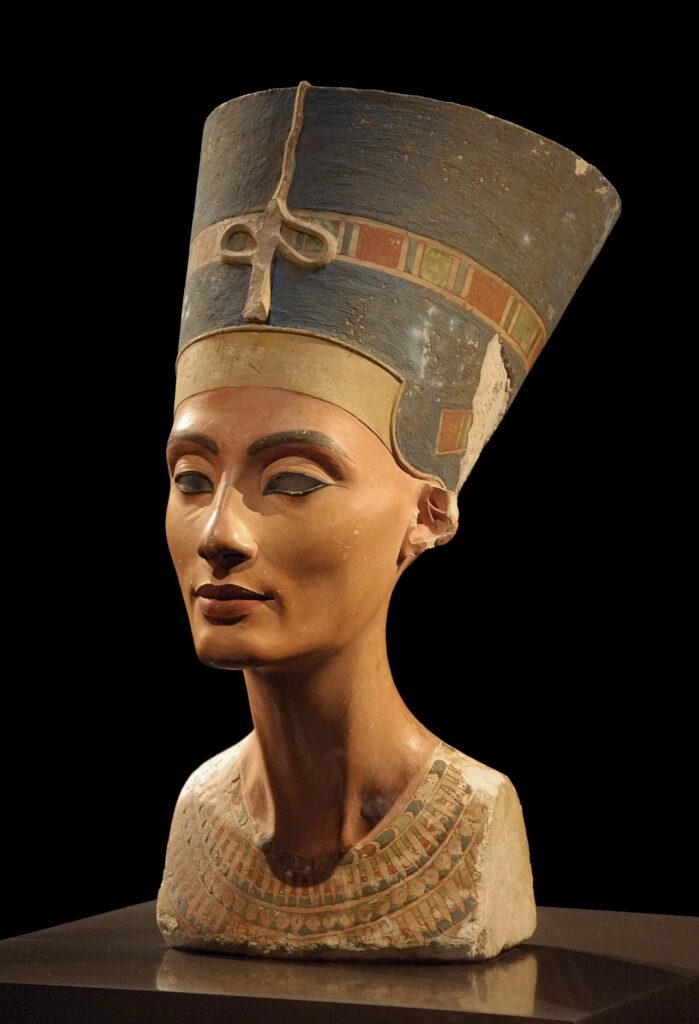
The Egyptian Book of the Dead — one of the foundational texts of ancient religion — stipulates that souls cannot speak certain spells in the afterlife unless they are clean and properly adorned with cosmetics. Spell 125 specifically demands the soul be ‘painted with eye-paint, anointed with the finest oil of myrrh.’ Even the gods were depicted wearing eye makeup. Cosmetics in Egypt were not decoration — they were divine.
What ancient Egyptians used — and why:
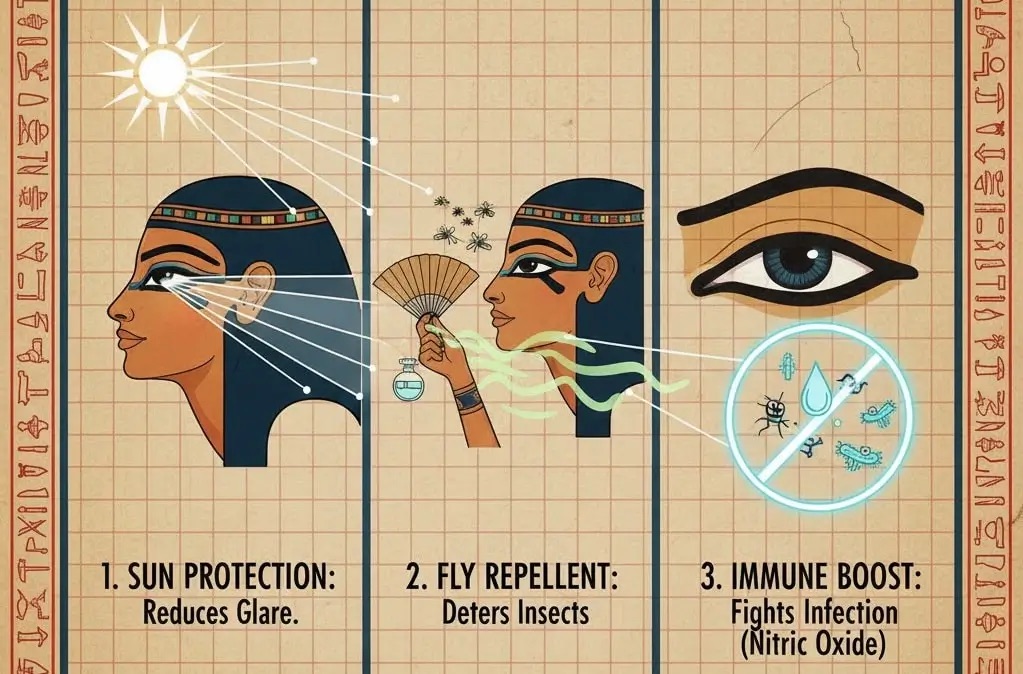
- Kohl (galena — lead sulphide ground with copper ore) — applied around the eyes as eyeliner. Served simultaneously as cosmetic enhancement, sunglare reduction (like modern athletes’ eye black), and documented antibacterial protection against eye infections. Modern research has confirmed that the lead compounds in kohl stimulated nonspecific immune responses that helped fight eye infections
- Malachite (bright green copper mineral paste) — applied as eye shadow. Green was the sacred colour of Horus and Re — wearing it connected the wearer to divine protection
- Red ochre mixed with fat — applied as lip and cheek colour. The colour red held powerful symbolic significance in Egyptian culture, representing life and power
- Moringa oil (ben oil) — the finest and most prized cosmetic oil in ancient Egypt. Used as a base for perfumes, as a skin moisturiser, and as a hair conditioner. Its extraordinary stability (it does not go rancid) made it the preferred carrier for precious perfume ingredients. Moringa is still growing along the Nile today — and still used in Egyptian natural skincare
- Castor oil — used extensively in hair care, skin moisturising, and as a base for cosmetic preparations. Still one of the most effective natural hair and skin oils available
- Almond oil and olive oil — used as skin moisturisers and bases for cosmetic formulations. Both remain fundamental to natural skincare
- Frankincense (Olibanum) — both as incense and ground into skin preparations. Used to treat wrinkles — ancient Egyptian cosmetic texts specifically mention frankincense as a wrinkle remedy. Modern science has confirmed boswellic acids’ anti-ageing properties
- Beeswax — used in hair setting preparations, skin protection, and lip care. Jars containing beeswax and resin ‘setting lotion’ have been found in Egyptian tombs with the contents still partly intact
- Henna — used to stain fingernails, fingertips, and feet. Still used in Egypt and across the Arab world today
- Saffron and turmeric — used as skin brightening preparations, mixed with other ingredients to even skin tone
The Egyptians also invented the world’s first professional cosmetics industry. Cosmetics manufacturers were respected specialists whose work was judged against the highest standards — both commercially (poor quality meant loss of business) and spiritually (poorly made products for religious ceremonies could anger the gods). Cosmetics were sold in marketplaces, but the finest quality was reserved for temples and royal courts.
Cleopatra VII (69-30 BCE) — the most celebrated beauty in ancient history — maintained her legendary appearance using this same tradition of Egyptian natural cosmetics. Historical accounts describe her bathing in camel milk to maintain the softness and luminosity of her skin. Modern science has confirmed that camel milk’s unique combination of alpha-hydroxy acids, vitamins, and lactoferrin makes it one of the most effective natural skincare ingredients available — exactly as Cleopatra understood.
Mesopotamia, Persia & The Ancient Near East | 3000 BCE – 600 CE
While Egypt was the most advanced cosmetics culture of the ancient world, the history of cosmetics in the broader ancient Near East is equally rich. In ancient Mesopotamia (modern-day Iraq), archaeological evidence shows cosmetics use dating to 3000 BCE — including kohl for eye decoration, red ochre for lips, and plant-based dyes for the face and hair.
Persian cosmetics culture was sophisticated and influential. Kohl (eye powder made by burning specific substances and collecting the smoke residue) was used extensively across the Persian Empire and spread westward through trade. Three items — jewellery, pottery, and seashells containing kohl — were buried with an ancient Emirati woman dating to approximately 2000 BCE, confirming the widespread regional use of cosmetics as both beauty products and grave goods.
Frankincense and myrrh — both tree resins from the Arabian Peninsula and East Africa — were among the most valuable trade goods in the ancient world precisely because of their cosmetic and medicinal applications. Their trade routes stretched from Somalia and Oman to Egypt, Greece, Rome, and China, making cosmetic ingredients among the first truly global commodities in human history.
Ancient Greece & Rome — Natural Beauty vs Artificial Enhancement | 800 BCE – 500 CE
Greek cosmetics reflected the philosophical values of the culture — an emphasis on natural beauty enhanced rather than artificially created. Greek women used light natural pigments to achieve a pale complexion (associated with aristocratic indoor life versus the tanned skin of outdoor workers), crushed berries for lip colour, and olive oil and charcoal to darken eyebrows. Greek men used scented oils extensively for both skin care and athletic preparation.
Roman cosmetics culture was more complex and internally contradictory. On one hand, Roman philosophers — particularly the Stoics — expressed a deep disdain for cosmetics, viewing artificial enhancement as morally suspect. The poet Sextus Propertius wrote that ‘looks as nature bestowed them are always most becoming.’ Seneca the Younger praised his mother specifically for never defiling her face ‘with paints or cosmetics.’
On the other hand, wealthy Roman women used cosmetics extensively — including some extremely hazardous preparations. White lead powder to lighten the face, chalk and white lead for skin whitening, kohl for eye liner, red ochre and wine dregs for lip and cheek colour, and imported carmine and malachite for those who could afford it. Roman cosmetics manufacture was a significant industry, with specialised shops and professional cosmetics makers serving the wealthy.
The Romans were also sophisticated in skin care products — distinguishing clearly between decorative cosmetics (which were morally questioned) and hygiene and skin care products (which were widely accepted for all genders). Bath soaps, deodorants, and skin moisturisers were in daily use across Roman society, making the Romans arguably the first culture to establish the modern distinction between skincare and makeup.
Medieval Europe & The Islamic Golden Age | 500 CE – 1400 CE
The fall of the Roman Empire did not end the history of cosmetics — it simply shifted its centre. While early medieval Europe largely abandoned cosmetics under the influence of Christian theology (which associated cosmetics with vanity and immorality), the Islamic world was experiencing a golden age of cosmetics science.
The Islamic Golden Age (8th-13th centuries) produced extraordinary advances in chemistry, medicine, and cosmetics. The Persian physician Avicenna (Ibn Sina, 980-1037 CE) — whose Canon of Medicine remained a standard medical text in Europe until the 17th century — specifically praised frankincense for strengthening memory and wrote extensively on the preparation and application of cosmetics. His work synthesised Greek, Persian, and Egyptian cosmetics knowledge into a systematic scientific framework.
Arab traders and scholars preserved and advanced the Egyptian tradition of botanical cosmetics, spreading the use of henna, kohl, rosewater, saffron, and natural oils across North Africa, the Middle East, Central Asia, and Spain. The concept of the hammam (public bath) — combining hygiene, skincare, and cosmetics in a social ritual — spread across the Islamic world, preserving and elaborating on many of the cosmetics traditions first established in ancient Egypt.
In medieval Europe, cosmetics were simultaneously condemned by the Church and eagerly used by the nobility. Women in medieval courts lightened their skin with egg white, chalk, and white lead. Red cosmetics for lips and cheeks were used despite religious disapproval. The tension between cosmetics as vanity and cosmetics as a social necessity in aristocratic settings characterised European cosmetics culture throughout the medieval period.
The Renaissance — Cosmetics as Art and Status | 1400 CE – 1700 CE
The Renaissance transformed cosmetics from a private necessity into a public art form. Italy and France emerged as the centres of European cosmetics production, and only the aristocracy had access to the finest products. Cosmetics were prepared by alchemists and apothecaries working for noble families — making cosmetics practitioners among the first professional chemists in European history.
Queen Elizabeth I of England became one of the most famous cosmetics users in history — creating what became known as ‘the Mask of Youth’ using ceruse, an extremely toxic lead-and-vinegar compound, to achieve the ghostly pale skin that was the era’s ideal of beauty. Despite causing significant health damage (including hair loss and skin deterioration), this practice continued throughout the Elizabethan period because the social and political benefits of maintaining the ideal appearance outweighed the known health risks.
The Renaissance also saw the emergence of the first recognisably ‘modern’ approach to cosmetics — the idea that skincare and cosmetics could be both scientifically formulated and commercially produced at scale. France in particular developed sophisticated perfumery traditions and began exporting cosmetics products across Europe — establishing Paris as the cosmetics capital of the Western world, a reputation that would persist for centuries.
The Industrial Revolution — Mass Production and Democratisation | 1700 CE – 1900 CE
The 18th and 19th centuries transformed cosmetics from an aristocratic luxury into a mass-market consumer product. The Industrial Revolution enabled the mass production of cosmetics at prices accessible to the middle and working classes for the first time. The history of cosmetics changed fundamentally — from hand-crafted, exclusive formulations to factory-produced, widely distributed products.
This period also saw the gradual recognition of hazardous cosmetics ingredients. The white lead that had been used in face powder for centuries was increasingly recognised as causing serious health damage, and safer alternatives like zinc oxide and talcum powder began replacing it. The 19th century also saw the first regulatory discussions about cosmetics safety — discussions that would eventually lead to formal cosmetics regulation in the 20th century.
In 1886, David McConnell founded the California Perfume Company in New York — which eventually became Avon, one of the world’s first and largest mass-market cosmetics companies. In 1915, T.L. Williams created Maybelline mascara for his sister Mabel. The modern cosmetics industry as we know it — branded, mass-produced, and commercially marketed — was born in this era.
The 20th Century — Science, Regulation, and the Beauty Industry | 1900 CE – 2000 CE
The 20th century saw the history of cosmetics undergo its most dramatic transformation since ancient Egypt. The development of organic chemistry enabled entirely new categories of cosmetics ingredients — synthetic fragrances, new pigments, sulphate-based cleansers, preservatives, and eventually petroleum-derived moisturisers and emulsifiers that became the foundation of mass-market skincare.
The post-war economic boom of the 1950s created an explosion in cosmetics consumption. Television advertising, celebrity endorsements, and department store beauty counters transformed cosmetics from personal care items into aspirational luxury goods with enormous cultural meaning. By the 1960s, cosmetics had become one of the world’s largest industries.
Formal regulatory frameworks for cosmetics emerged during this period. In the United States, the Food, Drug, and Cosmetic Act (1938) established safety requirements for cosmetics. In Europe, the EU Cosmetics Regulation established increasingly stringent safety standards that have led to the banning of hundreds of ingredients permitted in other markets.
The latter half of the 20th century also saw the beginning of the natural and organic cosmetics movement — a direct reaction against the synthetic, chemical-heavy mainstream cosmetics industry. Consumers increasingly questioned the safety of parabens, sulphates, synthetic fragrances, and petrochemical derivatives in their skincare products, driving demand for formulations closer to the botanical tradition that ancient Egypt had established 10,000 years earlier.
The 21st Century — The Return to Natural | 2000 CE – Present
The 21st century has seen the history of cosmetics come full circle — back to the natural botanical ingredients and mineral-based formulations that ancient Egypt pioneered. The modern natural skincare movement is not a rejection of science — it is the application of modern science to validate and refine the natural formulations that traditional cultures have used for millennia.
Ingredients like camel milk, black seed oil, moringa, frankincense (boswellic acids), pomegranate seed oil, jojoba oil, and red sea algae — all used in Egyptian cosmetics for thousands of years — are now among the most researched and clinically validated ingredients in modern dermatology. The Egyptian instinct that these ingredients were uniquely powerful has been confirmed by peer-reviewed clinical research.
Today, natural skincare Egypt represents one of the most exciting and authentic expressions of this global return to botanical cosmetics. At Organic Shop Egypt in Hurghada, we have been part of this story for over 20 years — sourcing, formulating, and shipping authentic natural Egyptian skincare products to customers across Europe and beyond, connecting the modern world to 10,000 years of Egyptian cosmetics wisdom.
Egypt’s Lasting Legacy in Modern Natural Skincare
The history of cosmetics begins in Egypt — and many of the most powerful ingredients in modern natural skincare are direct continuations of the ancient Egyptian tradition. Here is how the ancient Egyptian skincare canon maps directly to our modern product range at Organic Shop Egypt:
- Moringa oil (ben oil) — used in ancient Egypt as the finest cosmetic carrier oil — available today as our Nutra Health Moringa Greens Blend for internal skin benefits
- Castor oil — used in ancient Egyptian hair and skin preparations — still a core ingredient in our camel milk soap and collagen cream formulations
- Frankincense (Olibanum) — ancient Egyptian wrinkle treatment — the active boswellic acids are now confirmed as anti-inflammatory and anti-ageing by clinical research
- Almond oil — ancient Egyptian skin moisturiser — still a core ingredient in our Camel Milk Soap
- Beeswax — used in ancient Egyptian hair and lip preparations — still in use in modern lip balm formulations
- Camel milk — Cleopatra’s legendary bath ingredient — now the hero ingredient in our Camel Milk Cream and Camel Milk Soap, with its AHA content scientifically confirmed
- Saffron — used for skin brightening in ancient Egypt — now available as our Premium Iranian Saffron for both culinary and skin-brightening benefits
- Hibiscus — grown along the Nile for millennia — now our Egyptian Hibiscus Tea (Karkade), one of the richest plant sources of Vitamin C
Shop the Natural Skincare Egypt Legacy — Our Product Range
Every product in our natural skincare Egypt range is a direct expression of this 10,000-year tradition. Authentic ingredients, authentic origins, authenticated by modern science:
Egyptian Magic Organic Anti-Wrinkle Cream — from €15.00 — from €15.00
Camel Milk Cream — Cleopatra’s Secret — from €20.00 — from €20.00
Camel Milk Soap with Natural Oils — €4.00 — €4.00
Pomegranate Seed Oil — from €18.00 — from €18.00
Organic Jojoba Oil — from €18.00 — from €18.00
Egyptian Black Seed Oil — from €15.00 — from €15.00
Nutra Health Moringa Greens Blend 125g — €10.00 — €10.00
Premium Iranian Saffron 3g & 10g — from €10.00 — from €10.00
Egyptian Hibiscus Tea (Karkade) — from €6.00 — from €6.00
Blue Nila Face & Body Mask 200ml — €20.00 — €20.00
— Frequently Asked Questions —
❓ When did cosmetics first appear in history?
The history of cosmetics spans at least 10,000 years. The earliest evidence of cosmetics use comes from ancient Egypt, where both men and women were using scented oils and ointments as early as 10,000 BCE. Cosmetic grinding palettes — stone tools used to prepare pigments — have been found in Egyptian burial sites dating to 5000 BCE. The word ‘chemistry’ itself is believed to derive from ‘Kemet’, the ancient Egyptian name for Egypt, reflecting how foundational Egyptian cosmetics science was to the development of chemistry as a discipline. Egypt was not just the earliest cosmetics culture — it was the most sophisticated, producing professionally manufactured cosmetics sold in marketplaces and documented in medical papyri for over 3,000 years.
❓ Why were ancient Egyptian cosmetics so advanced?
Ancient Egyptian cosmetics were advanced for several interconnected reasons. First, the harsh Egyptian climate — extreme UV radiation, dry desert air, and sand-laden winds — created a genuine medical necessity for skin protection that drove continuous innovation. Second, Egypt’s unique geography provided an extraordinary range of powerful natural ingredients: moringa from the Nile Valley, malachite from the Sinai, galena from near Aswan, frankincense from Arabian trade routes, and camel milk from desert herders. Third, cosmetics were deeply integrated into Egyptian religion and the afterlife — which meant professional cosmetics manufacturers were motivated by spiritual as well as commercial incentives to produce the highest possible quality. Finally, the Egyptian tradition of writing down formulations in medical papyri (such as the Ebers Papyrus, dating to circa 1550 BCE) created a cumulative, documented knowledge base that allowed each generation to build on the discoveries of the previous one.
❓ How does the history of cosmetics connect to modern natural skincare?
The connection between ancient Egyptian cosmetics and modern natural skincare is direct and scientifically validated. Many of the key ingredients in premium natural skincare products today are exactly the same as those used in ancient Egypt — moringa oil, castor oil, almond oil, beeswax, frankincense, saffron, hibiscus, and camel milk. Modern clinical research has confirmed what ancient Egyptians understood empirically: these ingredients contain genuinely extraordinary active compounds. Camel milk’s alpha-hydroxy acids have been scientifically confirmed as exfoliating and brightening agents. Frankincense’s boswellic acids are clinically proven anti-inflammatories. Moringa oil’s remarkable stability and fatty acid profile make it outstanding as a cosmetic carrier. The 21st-century natural skincare movement is, in essence, a scientifically informed return to the botanical cosmetics tradition that ancient Egypt established 10,000 years ago.
❓ Where can I buy authentic natural cosmetics from Egypt?
Organic Shop Egypt in Hurghada has been sourcing and selling authentic natural cosmetics from Egypt for over 20 years — shipping worldwide via DHL Express to customers across the UK, Germany, Austria, Poland, Italy, the Czech Republic, and beyond. Our range includes products that directly continue the ancient Egyptian skincare tradition: Camel Milk Cream and Soap, Egyptian Black Seed Oil, Pure Jojoba Oil, Pomegranate Seed Oil, Egyptian Hibiscus Tea, Moringa Greens Blend, and a full range of collagen creams and natural face treatments. Everything is authentic, sourced directly from Egyptian manufacturers, and shipped at prices that reflect Egyptian production costs rather than European import markups. Visit our online shop at www.organicshopegypt.com or contact us via WhatsApp on +20 127 080 9139 — we speak English, German, and Arabic.
Explore Our Natural Skincare Egypt Blog
➜ Natural skincare Egypt — full guide: Natural Skincare Egypt: The Ultimate 2026 Guide to the Best Egyptian Products
➜ Camel milk soap benefits: Camel Milk Soap Benefits: 7 Proven Reasons to Switch from Liquid Soap
➜ Benefits of moringa: Benefits of Moringa: 9 Powerful Reasons to Use the Tree of Life
➜ Saffron tea benefits: Saffron Tea Benefits: What Happens After 14 Days
➜ Egyptian hibiscus tea: Egyptian Hibiscus Tea: 9 Proven Benefits of Karkade
➜ Blue Nila mask guide: Blue Nila: Egypt’s 5,000-Year-Old Brightening Secret
➜ Organic skincare Egypt: Organic Skincare Egypt: The Complete Guide to Egyptian Natural Beauty
Continue Egypt’s 10,000-Year Skincare Tradition Today
The history of cosmetics starts in Egypt — and at Organic Shop Egypt, it continues. Shop our authentic range of natural Egyptian skincare products, shipped worldwide from Hurghada via DHL Express.
Shop now: www.organicshopegypt.com/shop
WhatsApp: +20 127 080 9139 — English, German & Arabic spoken
History of Cosmetics — 10,000 Years of Beauty Wisdom from Egypt
Authentic natural skincare from Organic Shop Egypt — where history meets modern science.
Visit: www.organicshopegypt.com
DHL Express Worldwide | Secure Payment | 20+ Years Experience
Follow us: @organicshopegypt
© 2026 Organic Shop Egypt | Hurghada, Egypt | All Rights Reserved ��